Bridging Loans Explained – When and Why You Might Need One
New Paragraph
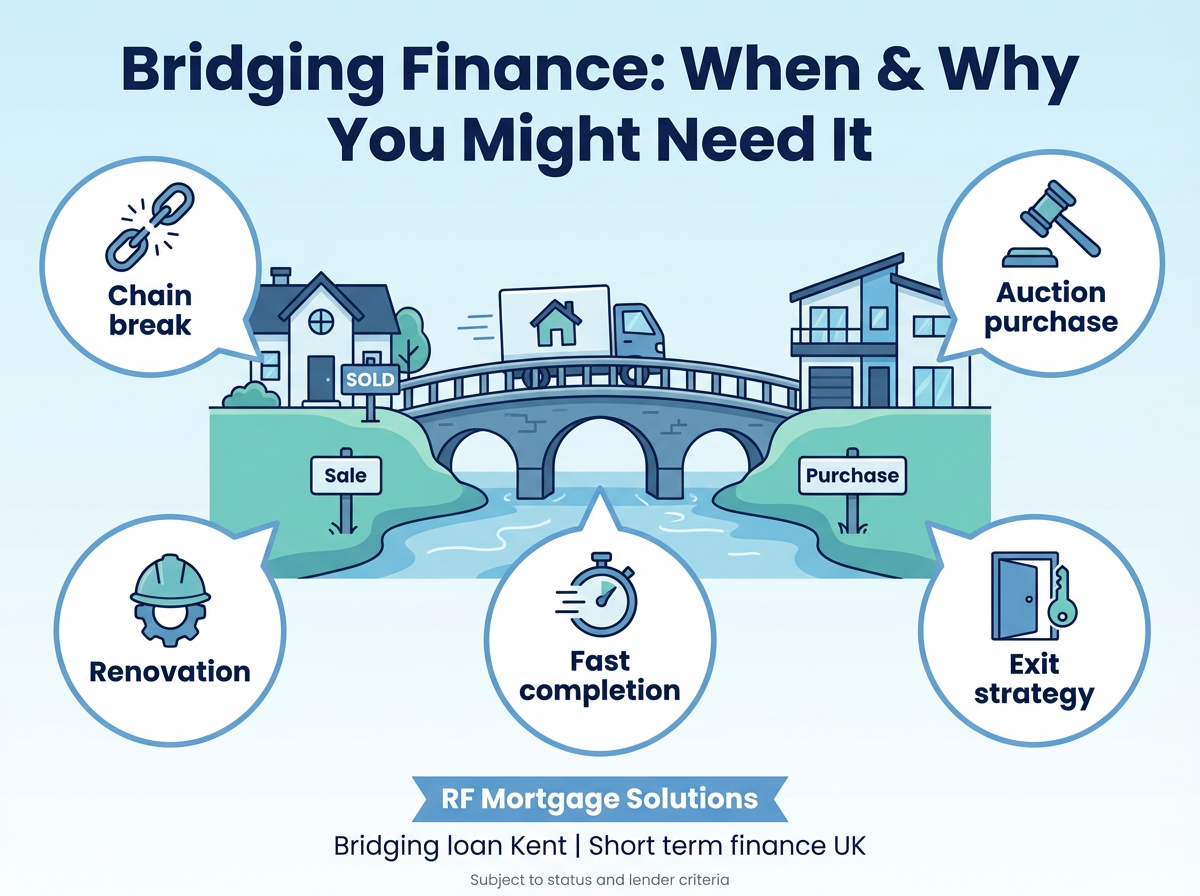
If you’re buying, selling, renovating, or investing in property, timing is often the biggest challenge. A bridging loan is designed to do exactly what it says on the tin: bridge a short-term funding gap when money needs to move faster than a standard mortgage.
In this guide, I’ll explain how bridging finance works, when it can help, what it typically costs, and the key risks to understand—especially if you’re considering a bridging loan in Kent and the surrounding areas.
What is a bridging loan?
A bridging loan is a short-term secured loan, usually secured against property (sometimes more than one property). It’s commonly used to fund a purchase quickly, then repaid when your “exit strategy” completes—most often:
· Selling an existing property
· Refinancing onto a standard mortgage
In the UK, bridging is typically designed to be repaid within around 12 months (some lenders may go longer), and it’s often used when a traditional mortgage is too slow or not currently possible.
Why people use short term finance in the UK
Bridging is a form of short term finance UK borrowers use when speed and flexibility matter more than long-term cost.
Common scenarios include:
· Buying before selling (avoiding a broken chain)
· Auction purchases (tight completion deadlines)
· Unmortgageable properties (e.g., needs renovation before a mainstream lender will consider it)
· Refurbishment or light development (then refinance once works are complete)
· Time-sensitive opportunities (e.g., below-market-value purchases)
How does a bridging loan work?
At a high level, the process looks like this:
1. You identify the funding gap (purchase price, deposit, refurbishment costs, etc.)
2. You agree an exit strategy (sale or refinance)
3. The lender takes a legal charge over the property (or properties)
4. Funds are released (often faster than a mortgage)
5. You repay the loan when the exit completes
Because the loan is secured, your property is at risk if you don’t keep up repayments.
Types of bridging loans (in plain English)
Open vs closed bridging
· Closed bridging: you have a clear, time-bound exit (e.g., an agreed sale). Often cheaper.
· Open bridging: no fixed repayment date, but lenders typically still expect repayment within about a year.
First charge vs second charge bridging
· First charge: the bridging lender is first in line to be repaid (common if the property has no mortgage).
· Second charge: there’s already a mortgage in place, and the bridging lender sits behind it. This can be more complex and sometimes more expensive.
Regulated vs unregulated bridging (important)
In the UK, bridging can be:
· Regulated (FCA-regulated): typically when the loan is secured on a property you live in (or intend to live in).
· Unregulated: often used for business purposes or property investment, and it doesn’t have the same consumer protections.
A good broker will help you establish which category applies and what that means for your options.
How much can you borrow?
Bridging is usually based more on the property value and equity than on income.
A common maximum is around 75% loan-to-value (LTV), though it varies by lender, property type, and the strength of your exit strategy.
How much does bridging finance cost?
Bridging is generally more expensive than a standard mortgage because you’re paying for speed, flexibility, and specialist underwriting.
Costs can include:
· Interest (often calculated daily; may be paid monthly or “rolled up” and repaid at the end)
· Arrangement fees
· Valuation fees
· Legal fees
· Potential broker fees
Because it’s short term finance, it’s crucial to model the total cost over the expected term and build in a contingency if your exit takes longer than planned.
Key risks to understand (before you commit)
Bridging can be incredibly useful—but it’s not something to take lightly. Key risks include:
· Exit strategy risk: if your sale falls through or refinancing isn’t possible, the loan can become expensive quickly.
· Property risk: as a secured loan, failure to repay can lead to repossession.
· Cost creep: delays can mean additional interest and fees.
· Market movement: if values drop, refinancing at the end may be harder.
Bridging loan: examples where it can help
In Kent (Ashford, Canterbury, Maidstone, Tunbridge Wells and beyond), bridging often comes up in very practical situations:
· A buyer finds the right home but their sale is dragging on
· A landlord needs to complete quickly on a purchase that requires work
· A property is temporarily unmortgageable due to condition, and bridging is used until it’s brought up to standard
The principle is the same UK-wide, but local market speed and chain complexity can make bridging particularly relevant.
Alternatives to consider
Before committing to bridging, it’s worth checking whether a cheaper or lower-risk option could work, such as:
· A standard mortgage (if timescales allow)
· Remortgaging or further advance (where appropriate)
· Let-to-buy (in some home-move situations)
· A secured loan (depending on circumstances)
When a bridging loan is (and isn’t) a good idea
A bridging loan can make sense when:
· You have a clear, realistic exit strategy
· You need funds quickly and a mortgage won’t work in time
· The numbers still stack up even if the exit is delayed
It may not be suitable when:
· The exit is uncertain or relies on “best case” assumptions
· You’re already stretched and delays would cause financial strain
Next step: get advice before you apply
If you’re considering short term finance UK options, it’s worth getting proper advice first—bridging is specialist, and the right solution depends heavily on the property, the timeline, and your exit plan.
If you’d like, tell me:
· Where the property is (Kent or elsewhere)
· Whether it’s residential, buy-to-let, or semi-commercial
· Your planned exit (sale or refinance)
· Your ideal timescale
…and I can suggest what information you’ll need and the key questions to ask before proceeding.
How RF Mortgage Solutions Can Help
Navigating bridging finance can be complex, especially when timelines are tight and every detail matters. RF Mortgage Solutions, based in Ashford, Kent, works closely with a wide network of specialist lenders to help clients secure the right bridging loan in Kent for their circumstances.
Whether you’re purchasing at auction, managing a property chain delay, or funding a refurbishment project, the team provides tailored guidance and helps structure a clear exit strategy. With access to competitive short term finance in the UK, RF Mortgage Solutions aims to make the process smoother and faster for property buyers and investors.
Your home or property may be repossessed if you do not keep up repayments on a mortgage or any other debt secured on it.