Update: Should I Fix My Mortgage Now or Wait?
Should I Fix My Mortgage Now or Wait?

Should I Fix My Mortgage Now or Wait?
A 2026 Guide for Homeowners and First-Time Buyers
Updated: 29 August 2026
Mortgage rates have been on something of a rollercoaster during 2026, leaving many homeowners and first-time buyers asking the same question:
👉 “Should I fix my mortgage now, or wait and see what happens to rates?”
It's an understandable question — but trying to predict exactly where mortgage rates will go next is extremely difficult.
Let's look at where the market stands today and, more importantly, the factors you should consider when deciding what is right for you.
📊 What's Happening with UK Mortgage Rates?
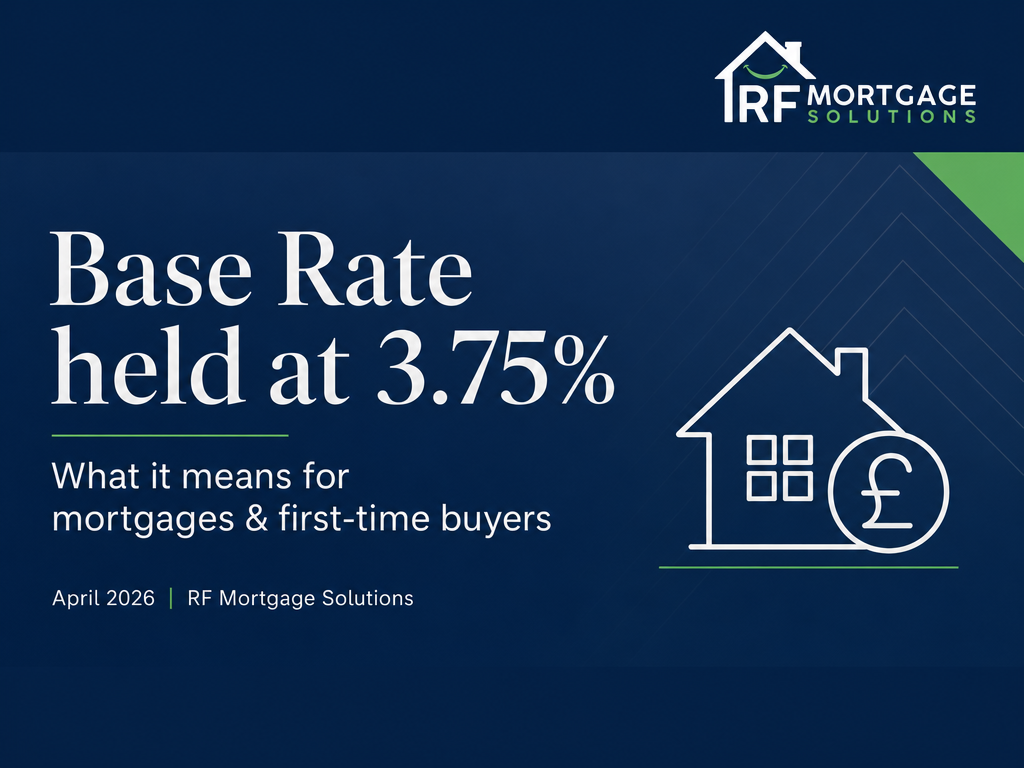
As of 29 August 2026, the Bank of England Base Rate stands at 3.75%.
Earlier in the summer, fixed mortgage rates had been gradually improving. However, that trend has become less straightforward, with mortgage pricing moving higher again during August amid changing inflation expectations, volatile financial markets and continued geopolitical uncertainty.
This highlights an important point:
Mortgage rates don't move solely because the Bank of England changes the Base Rate.
Fixed mortgage pricing is heavily influenced by financial market expectations about where interest rates and inflation may be heading in the future. This means lenders can increase or reduce their fixed rates even when the Bank of England leaves Base Rate unchanged.
At present, the outlook remains uncertain. Inflation and global events continue to present risks, while expectations about future Bank of England policy can change quickly.
For borrowers, this means waiting for a significantly lower mortgage rate isn't necessarily guaranteed to pay off.
🔐 What Does Fixing Your Mortgage Actually Mean?
When you choose a fixed-rate mortgage, your interest rate — and therefore your monthly mortgage payment — is normally fixed for an agreed period, commonly two, three or five years.
✅ Benefits of fixing
- Predictable monthly mortgage payments
- Protection if mortgage rates rise
- Easier household budgeting
- Peace of mind during periods of market uncertainty
⚠️ Things to consider
- You may not benefit if mortgage rates subsequently fall
- Early Repayment Charges (ERCs) will usually apply during the fixed period
- There may be restrictions on how much you can overpay
- A longer fixed period may provide less flexibility if your circumstances change
The question therefore isn't simply whether fixed rates will rise or fall.
It's whether the certainty offered by a fixed rate is valuable to you.
❓ Should You Fix Your Mortgage Now?
Rather than trying to predict the market, I generally encourage clients to consider a few more practical questions.
1. How important is certainty to you?
If knowing exactly what your mortgage payment will be every month is important to your household budget, a fixed-rate mortgage can provide valuable certainty.
This may be particularly relevant if your finances would be stretched by an unexpected increase in mortgage payments.
2. What would happen if rates increased again?
Tracker and variable-rate mortgages can offer greater flexibility and, in some circumstances, may initially be cheaper than comparable fixed rates.
However, your payments can change if the underlying interest rate changes.
Before choosing this route, consider whether you could comfortably afford your mortgage if rates moved higher.
3. What if mortgage rates fall?
This is often the reason borrowers consider waiting.
If mortgage rates fall after you've fixed, you could find yourself paying a higher rate than new customers are subsequently offered.
However, waiting also carries a risk.
Rates could remain broadly where they are — or rise.
The decision therefore comes down to balancing the potential benefit of future rate reductions against the certainty available today.
4. How long do you expect to stay in the property?
Your future plans matter.
If you expect to move home in the next couple of years, committing to a longer fixed-rate period with substantial Early Repayment Charges may not provide the flexibility you need.
Equally, if you're planning to stay in your home for many years and value payment certainty, a longer fixed period may be worth considering.
5. Is a tracker mortgage worth considering?
Fixed rates aren't the only option.
Depending on the market and your individual circumstances, a tracker mortgage may offer an alternative for borrowers who are comfortable accepting fluctuations in their monthly payments.
Some tracker mortgages also offer greater flexibility, including products without Early Repayment Charges.
The important thing is to compare the overall features, risks and costs, rather than choosing solely on the headline interest rate.
📌 Don't Just Compare the Interest Rate
One of the biggest mistakes borrowers can make is assuming that the mortgage with the lowest headline rate must automatically be the cheapest.
It isn't always.
When comparing mortgages, consider the total cost of the deal, including:
- Arrangement or product fees
- Valuation fees
- Legal costs
- Cashback or incentives
- Early Repayment Charges
- Overpayment allowances
- The interest rate
- Your expected mortgage balance
For example, paying a large product fee to secure a slightly lower interest rate may make financial sense on a larger mortgage — but could be poor value on a smaller mortgage.
This is why comparing the overall cost is so important.
💬 A Typical Client Conversation
A common situation I see is a homeowner approaching the end of their current fixed-rate deal and wondering whether they should secure another fixed rate or wait in the hope that rates fall.
Rather than trying to predict exactly what the Bank of England will do, I look at the client's wider circumstances:
How much certainty do they need?
How comfortable would they be if rates increased?
Could they benefit from flexibility?
Are they likely to move home?
What would fixing for two years versus five years mean for their plans?
For some clients, a shorter-term fixed rate may provide a balance between certainty today and the opportunity to review the market again sooner.
For others, the security of knowing their mortgage payment for a longer period is far more important.
And for some borrowers, a tracker or other flexible mortgage may be worth considering.
There isn't one answer that suits everybody.
🏁 So, Should You Fix Now or Wait?
As of August 2026, the mortgage market remains uncertain.
While the Bank of England Base Rate is currently 3.75%, fixed mortgage rates can still move independently as lenders respond to inflation expectations, swap rates, economic data and events around the world.
Trying to perfectly time the bottom of the mortgage market is therefore extremely difficult.
Instead, I'd focus on a different question:
👉 “Which mortgage gives me the right balance of cost, certainty and flexibility for my circumstances?”
Whether you're a first-time buyer, home mover or approaching the end of an existing mortgage deal, the right decision should be based on your finances, future plans and attitude towards interest-rate risk — not simply a prediction about where rates might go next.
If your mortgage deal is approaching its end, it's also worth reviewing your options early rather than waiting until the last minute.
💬 Need Help Reviewing Your Options?
If you're unsure whether to fix, track or wait, I'd be happy to review your circumstances and talk you through the options available.
📞 Book a free initial 30-minute mortgage review
YOUR HOME MAY BE REPOSSESSED IF YOU DO NOT KEEP UP REPAYMENTS ON YOUR MORTGAGE
About the Author
Richard Forgione — Mortgage & Protection Adviser, Founder & Director at RF Mortgage Solutions
With more than 30 years' experience in financial services and over 15 years specialising in mortgage advice, Richard helps first-time buyers, home movers, homeowners, landlords, self-employed clients and those with more complex mortgage needs across Kent and nationwide.